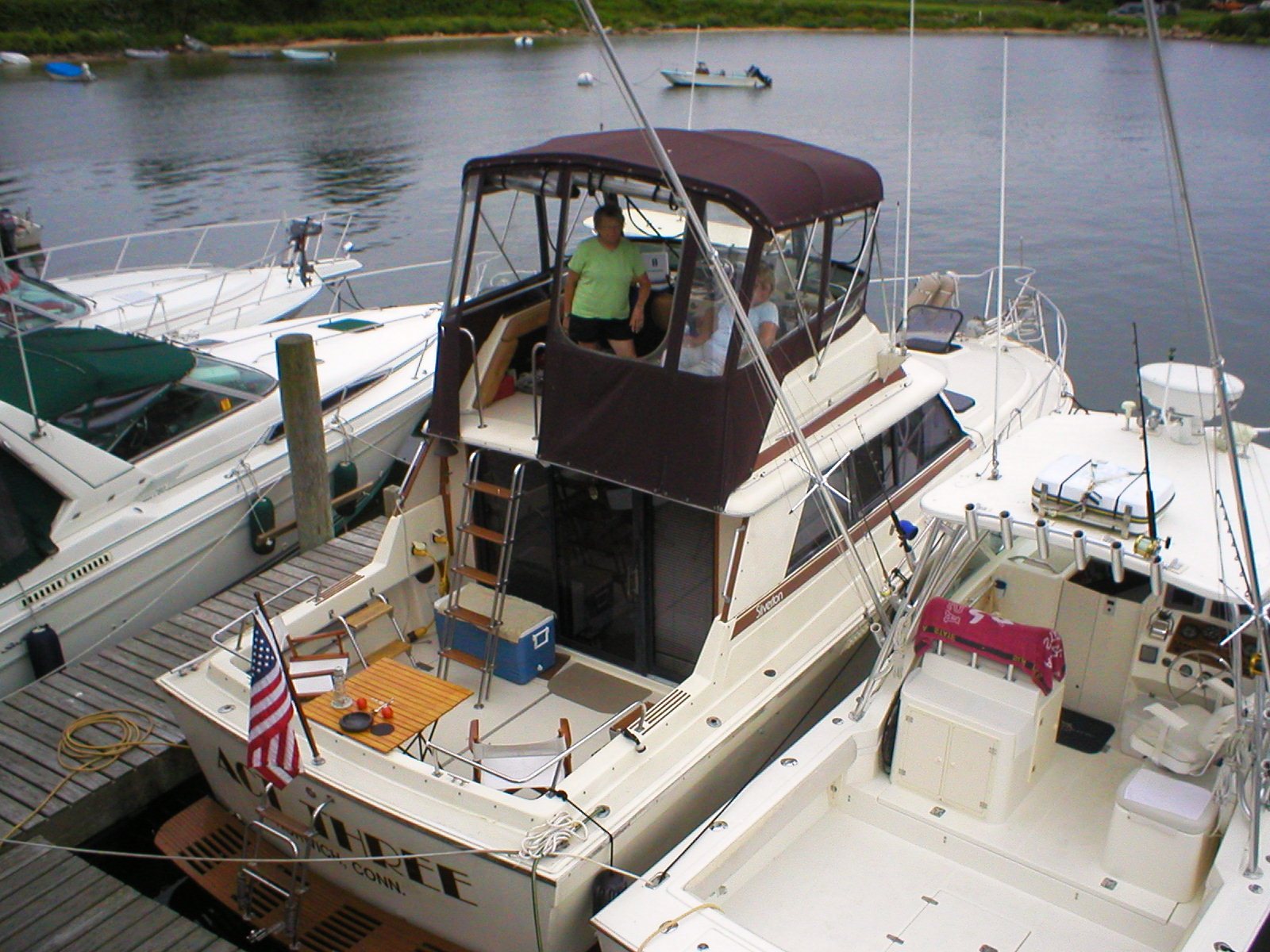
This blog is about our experiences enjoying and maintaining our 1980 Silverton 34C powerboat.
Tuesday, August 30, 2011
Our date with Irene
Like every other boater on the east coast, we'd been watching hurricane Irene for almost a week. Soon, it was apparent that it this large storm was going to waddle slowly up the coast from North Carolina and finally get to us. As it turned out, that's what happened just in time for the weekend.
Knowing what was in store, we went down to Norwich, CT where we keep the boat on Saturday morning and met virtually everyone on our dock, each of whom was adding lines, tying down their inflatables and checking their canvass. We had to remove our bridge enclosure, which would have given us way too much sail area for the expected 75 mph winds. The boat looked strange without it.
Late Saturday afternoon, virtually everyone had left and that left us. Our plan was to stay on the boat during the hurricane and that's what we did. But, with everything ship-shape late Saturday, we decided to walk the docks and see the many boats that had arrived at our marina to escape the storm. We're 13 miles up river from Long Island Sound and the marina offers good storm protection.
Frances brought a camera and decided that we should shoot many of the boat names and post them here on our blog. Here's her selection:
Don't know what this boat was but it looked like an old Trumpy. It was about 70 feet long.
"Freedom" was Bill's favorite. A really beautiful lobster-yacht with teak covering boards and swim platform. And yes, that's the way teak is supposed to look.
This has to be the best boat name of the weekend. We have to assume that the owner has some connection to the place where America gets its coffee in the morning. Even the typeface is perfect.
We loved the name, "Mean Doreen." It appeared to be a charter boat, and a really nice one.
We have no idea what this means or where the hailing port is.
We also had several really big boats. Here are two of them, tied up to our former gas dock. The boat in the foreground also had an anchor out. The really big boat the background had two anchors out. Guess that why those captains get the big bucks.
"Thirteen," the bigger of the two boats, also had a tender, tied up at a separate dock. Nice tender, don't you think?
We went to sleep on Saturday night with no wind or rain. Pooka, our boat cat, helped Bill read himself to sleep.
We awoke on Sunday morning early with the sound of the boat hitting the piling on our starboard side. We had expected the storm to hit from the west but it was from the east instead, so we got up and ventured out into the howling wind and rain. Luckily, the owner of another Silverton who was visiting to escape the hurricane, gave us a hand and we adjusted to lines.
At that point, we had cable and electric service and we watched the TV coverage of Irene's progress until, first the cable service failed, and then the marina shut down the electric. Not to be stopped for one minute, Frances broke out the butane stove and cooked a great breakfast. We switched on a computer running on batteries and continued to follow the path of the storm. We even sent a email to our dockmates telling them that while the wind was blowing like hell, all the boats were safe.
The rest of Connecticut wasn't so lucky. Irene downed trees that took out the power to more than 100,000 homes. Sometimes, it's better to be on a boat.
Eventually, the wind and rising tide subsided and we left the boat for a quick trip home. All in all, it was an interesting experience. Nothing broken or damaged on the old boat but we did end up with something that we can look back on in future years.
Speaking of looking back, we took a picture of a nearby piling and if you look closely, you can see how far up the water actually came, even here in eastern Connecticut where the storm was far from its worst.
Thursday, August 25, 2011
Greenport in August
Greenport, Long Island has always been one of our favorite cruising destinations. There was a time when we'd visit for just a weekend but with fuel prices so high, it makes sense to go and stay a while. We dock at Mitchell Park Marina, Greenport village's beautiful marina in a park right on Front Street. We left on August 16 and returned on August 19.
Unless there's a special event of some kind, the marina is almost never crowded during the week.
As usual, we met lots of nice boaters. We got to know a couple from Gales Ferry who were docked next to us. They had three poodles that were very well behaved and fun to watch. They left for home the next day. Sorry we didn't get any pictures of the poodles.
For you boaters out there, "Gulliver" is a 1983 Silverton 31X, in very nice shape. We love to see older boats kept up properly. By the way, this one is for sale.
As the days passed, new boats arrived and others left. Here's an interesting pair: A very nice little 25-ft. red picnic boat docked next to a big blue cruiser from Florida. We didn't meet the owners but enjoyed the color contrast.
Speaking of color, how's this? It's Frances preparing dinner at the table in our cockpit. She looks a little stressed here but she certainly wasn't. Maybe it was the onion she was cutting.
The picture at the beginning of this blog entry is the Margaret Rose, a fishing boat sporting a new coat of paint. She left to go fishing the next day. These draggers tie up at Greenport's Railroad Dock and have become the village's logo. At the other end of the dock was Predator, which, we're afraid has seen her last days of fishing. This boat has been on the Railroad dock for years.
Soon, we were surrounded by sailboats and we got to meet their owners and crew members too. Sail or power, boaters are just nice people!
We dropped our inflatable in the water, mounted our mighty 2 hp. Honda engine and took a ride to Sterling Harbor, where we spent so many great times at Doug's Dock long before Mitchell's was built. We beached the inflatable right at the entrance (called Sandy Beach), inspected the Osprey nest and wondered along the beach on a beautiful, warm afternoon. Frances collected shells and she got some nice ones!
Frances runs a pretty tight ship on our cruises and that includes drying our towels on the bow railing.
There are more photos from this trip but they are on Frances' camera. Perhaps she'll add them to this blog. If not, we'll get them on soon.
Friday, August 5, 2011
Refurbishing the shore cords
The shore cords on our boat have taken a beating this summer. We have two 30-amp power plugs connected via a Y-cable to the dock power pedestal with a single 25-ft. 30-amp shore cord. The air conditioner runs on one plug and the rest of the boat on the other. With the AC chugging during most of the daylight hours this past month, combining those two plugs into one 30-amp cord began to heat up the connectors and earlier this week, one failed. We replaced the Y-cord and the 25-ft. cord to the dock with new ones that should last several seasons at least, but it made us think about replacing the plugs and connectors on our old cords. We also have a 50-ft. cord that we use when cruising. This allows use to leave our 25-ft. home marina cord at the dock (with the cable TV cable attached to it.)
The old connector that failed looked pretty nasty.
All of our cables were manufactured by Marinco and were pretty old, one going back a boat or two. While you can buy Marinco replacement male and female connectors, you can't disassemble the old plugs since they are molded to the ends of the shore cord. We did some investigation and found that replacement plugs made by Hubbell (right here in our home state of Connecticut) seemed to be of a lot better quality. We were going to replace at least one connector on two shore cords and one Y-cord, so here's what we ordered:
1 - Hubbell 305CRC 30A Female Connector - $20.95
2 - Huibbell 305CRP 30A male connector - $12.95 each
1 - Hubbell 102 boot - $10.95
2 - Hubbell 103R boot - $16.95 each
With $9.95 for shipping, the whole project totaled $109.65. Not too bad considering this put back in service two shore cords and a Y-cord that together would have cost $400.00 or more new.
In case you want to do a similar project, note that the Hubbell connectors shown on the top pages of most marine parts websites are a cheaper version that have an external clamp to hold the cable. They are far less waterproof that the ones we ordered and do not have a boot. Drill down and you'll find the good ones.
We began by cutting off the old connectors with a hacksaw.
Then we cut off 1-1/4 inch of the outside insulation. We found it necessary to follow the stripping dimensions carefully because they made a difference when we assembled the first connector.
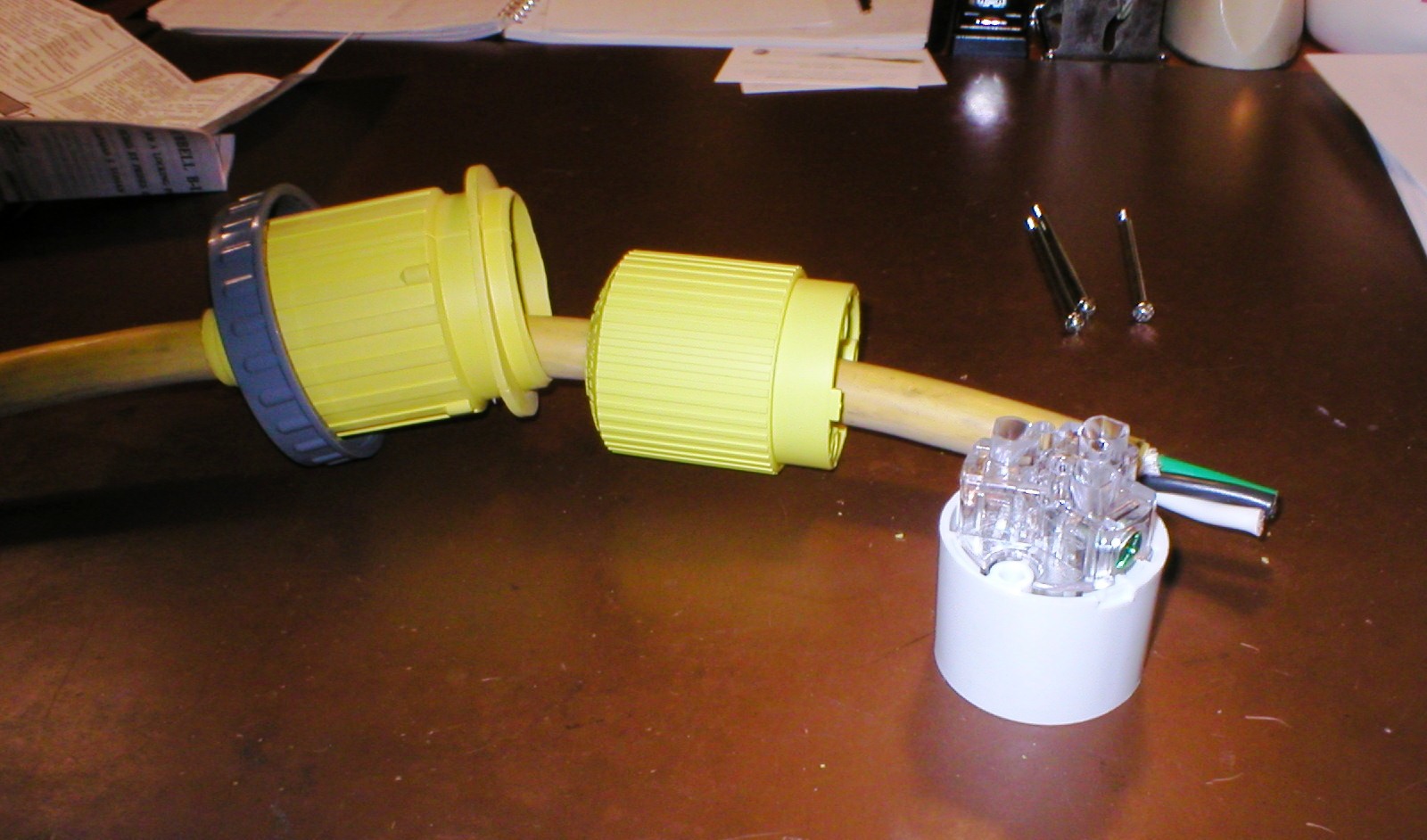
With the outside insulation off, it was time to assemble all the loose pieces on the cable. If we forgot to do that now, we'd have to disassemble and do it all over again.
As the directions indicated, we trimmed just 5/8-inch of the insulation from the three #10 wires.
Five-eighths of an inch didn't look like enough but when we slid the three wires into the end assembly and tightened down the screws, it made a very neat installation.
Then we slid the pieces together. There is keyway on the end assembly that fits the collar. Once we found it, we were able to slide the pieces together and insert the three stainless screws. As we tightened each one a little bit at a time, the collar drew up tight on the wiring end assembly. While you can't see it at this point, those screws were also tightening down on a three clamping pieces inside the connector that hold the cable very securely.
Our final step was to slide the boot up the cable and over the connector itself. The boot appeared to be too small but with some careful tugging it did finally seat, nice and tight around the connector.
Here's the male version mounted on the Y-cable. All in all, a nice little job for cocktail hour that can save a few bucks.
Sunday, July 31, 2011
Block Island
Our annual trip to Block Island began with the arrival in Norwich of our friend Ellen Creighton who took the ferry from Orient Point. We loaded up our stuff and headed downriver to get gas at the Shennecossett Yacht Club in Groton. There we took on 151 gallons of gas (expensive, we know, but that's the price of boating these days) and then went east in Fisher's Island Sound and went out at Watch Hill. It is 15 miles to Block Island from there.
We were aware that the weather wasn't good and in fact there was a small craft advisory posted for Block Island Sound. The first mile or so wasn't bad under a bright sun but as we got farther out, we began to encounter some large rollers from the southwest. We surfed through them but had to pay particular attention to keeping our exact heading because if we drifted off it, we either turned into the rollers or went broadside to them, neither very comfortable. Frances was below, trying to hold the furniture in place and Ellen stayed on the bridge with Bill.
About five miles out, our starboard engine quit and with the seas that big, we were unable to go below and see what the problem was. We increased power on the port engine and continued out at about 9 miles per hour. It was quite a struggle keeping our heading on one engine, but we did. About five miles from Block, we heard another boat also heading for Block reporting dense fog on the radio. What else could happen?
As we got closer to New Harbor inlet, the fog began to close in. We managed to stay on our course and watched for Block to show up on the radar, which it eventually did. As we got closer to the inlet, the density of the fog increased and it was a relief when Ellen spotted the red sea buoy at the inlet. We motored in but found a big wind still blowing from the southwest in Great Salt Pond. We were unable to steer effectively against it as we entered the mooring field and ended up trying to anchor in very shallow water at the north side of the pond. Luckily, another boater saw our situation and called TowBoat US. Doug, the TowBoat Captain, arrived and towed us to an empty mooring. That was an expensive tow but it was accomplished before we did any damage to the boat.
Once on the mooring, we sorted out the boat's interior and when we tried the starboard engine, it started instantly. Oh well, another engine mystery to solve. We decided to take the launch ashore and get some dinner and figure out the engine problem in the morning.
The next morning, after a good snooze, we changed the fuel filter/water separator cartridge on the starboard, engine, started up and left the mooring for Payne's.
With both engines running fine, we managed to dock at Payne's with only a minor bump to our inflatable. We were "around back" at Payne's, which is not our favorite spot but comfortable enough with some nice neighbors.
We stayed at Payne's for five days, taking a while to get on "island time," visiting one of our dockmates at a mooring in our inflatable and generally doing what everyone does there; go to the shops, take walks,get to the library and generally enjoy what turned out to be pretty good weather.
As always, we met some interesting people. One couple arrived in a nicely restored Chris-Craft that everyone commented on. Once back home, we consulted Jerry Conrad's book, Chris-Craft: the Essential Guide because Brian, the boat's owner, had only identified as a "1953 Chris-Craft." While we can't be absolutely sure, because Chris-Craft made a lot of boats of this style and type, Brian's boat appeared to be a 25 ft. Enclosed Cruiser, a boat that was made from 1951 to 1953. Chris-Craft made 224 of these popular boats during those years and we suspect that Brian has one of the few left. We wish him many good years with it. He keeps it at Fort Rachel in Mystic, where we like to visit. Hopefully we will see him there in the future.
After years of being the same old place, Payne's has changed. Cliff and Sands have built a beautiful big pine paneled dining room above a portion of the old building. Now you can walk upstairs and watch all the action at the dock.
On Tuesday, we left Block Island. Our plan was to head west to Greenport, Long Island and drop off Ellen. The weather was perfect and the cruise down Block Island Sound was wonderful except, after about two hours at our cruising speed, the starboard engine stopped again. We were close enough to Greenport by then and as we entered the Greenport breakwater, we restarted the starboard engine and docked without drama. This problem was getting annoying. Ellen was kind enough to take us to Larry's Lighthouse Marine in Riverhead where we purchased some extra fuel filters. But when we examined the old filter it was clean as was the little filter at the fuel inlet on the carb.
On Wednesday morning, we left Greenport for home. The starboard engine ran flawlessly until we were about to enter New London harbor (again about two hours of running time) but this time we simply throttled it back and took it out of gear, where it idled happily as we ran up the river on our trusty port engine. Once again, the starboard engine worked fine for docking, so that's a problem that we'll have to figure out.
We have one common 220-gallon fuel tank feeding both engines so it's not bad fuel. What runs perfectly for two hours and then causes the engine to lose power? We suspect the ignition coil, since they do fail when they get hot. We have since replaced it, although it was replaced last summer on that same engine. Everything on that stinkin' starboard engine has been replaced, including rebuilding the carb. We had three bad coils over three years on, coincidentally, the starboard engine, on our old Chris-Craft, so maybe that's it.
The issue now is that we'll have to take a two-hour plus cruise to see if the coil was the problem. Isn't boating fun?
Just for the record, our Norwich-Block Island-Greenport-Norwich trip covered 148.9 miles. If we can believe the fuel gauge, that consumed about 150 gallons of fuel so we're running about one mile per gallon.
Subscribe to:
Posts (Atom)