Sunday, May 26, 2013

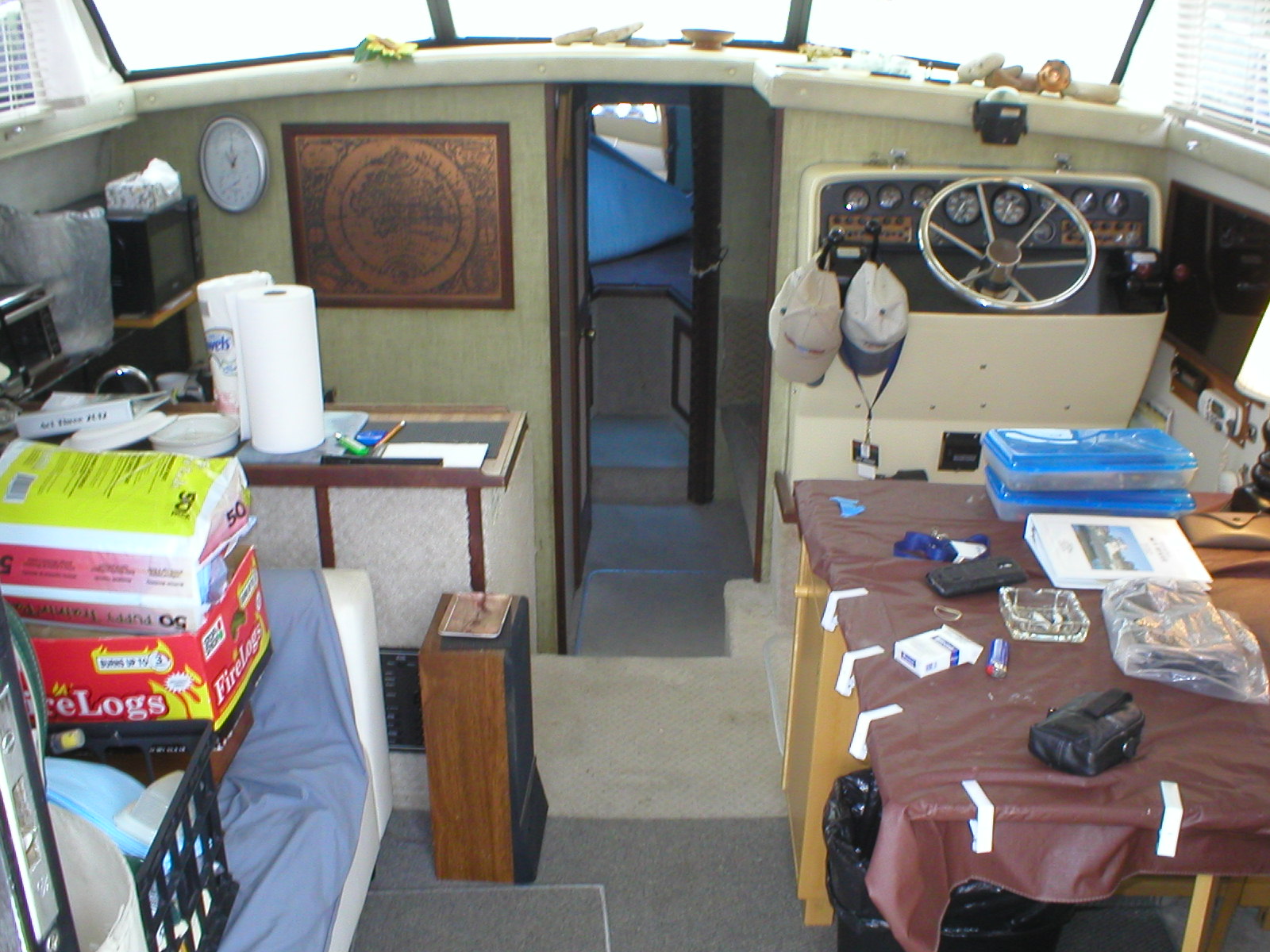
Where the hell did all this stuff come from?


To be honest, all this stuff came off the boat last fall, was carefully packed away in our basement and is now back, ready to be put away.


And there's more in the v-berth, even our purple sheets.


This is our first weekend at our summer marina and like lots of others, it was time to unload and get ready for a great summer.  Our work plan for Saturday was for Bill to haul stuff down and then thoroughly vacuum the boat, wash the windows, etc.  It is much easier to have one person vacuum and we used our baby shop vac to suck up whatever had accumulated over the winter.

We should mention that the weather was terrible with rain just about all day on Saturday and lots of wind. Long Island Sound had a gale warning up but that's okay because we were nice and dry as we waltzed around with the vac.

With the interior of the boat clean, Frances arrived just in time for cocktail hour. This is also part of our work plan. Bill cleans and Frances puts everything away and makes the boat livable.


There would be no cooking tonight so we went for a fairly good pizza, delivered right to the boat.  We weren't the only people on A-dock to summon the pizza guy, believe me.


Frances made up the sparkling clean v-berth and we hit the sack fairly early.

On Sunday morning, Frances broke out the pots and pans and served up an excellent omelet while Bill dug into The New York Times. After breakfast, Frances washed the dishes and stacked up everything in her favorite dish drainer. That woman could fit dinner for eight in that thing!


Then the unpacking began with the most important things installed first. That round glass thingy that resides on the cabin door was first...


And then the bird, actually a wind chime.


With that out of the way, Bill applied himself to cleaning the cockpit and doing a little touch up in the engine space.


Then it was time to stop working and join everyone else on the dock in helping our friends Ron and Sue bring their 27-ft. Carver, Obsession, in for the first time this season.


Frances prepared what has almost become a tradition on our dock: once a boat docks for the first time, the gang on the dock holds up paper plates to score their docking skills. As you might imagine, everyone gets either a "9" or a "10."


This docking wasn't going to be easy since as soon as Ron turned to back in, the very strong wind was going to hit is starboard side and push him away.


And that's what happened, but Ron's long experience and the extra hands on the dock got them in safely.


Here's the crew talking through the usual after-action report.


These are people who, among others, make boating fun for us. From left, Bob, Mike, John, Sue, Joanne, Barbara and Frank.

Speaking of Frank and Barbara, here's a picture of them (at left) with their new boat, an absolutely beautiful 1997 Silverton 351 that they brought down from Rhode Island just three days ago.

We join everyone on A-dock in wishing them the best with their new boat.


Saturday, May 18, 2013

Underway, for another summer

At 8:45 AM today, we fired up the Old Chryslers, loaded our stuff aboard, and backed out into the Connecticut River for the trip to Norwich.

It was cold and windy on the river but that didn't dampen our enthusiasm. We followed a large trawler-type vessel all the way tom East Haddam where he had to stop and wait for the swing bridge to open.  Not us. We slid under with a foot or two to spare.

There were very few boats on the river, probably because of the cool weather. To save some money, we ran at 2100 rpm which gave us about 10 mph. An outgoing tide gave another one mph lift. That's a very economical speed for us and we were in no hurry.

We passed through Essex all by ourselves.


We assume that those yellow markers are for the sailboat races. Never have seen those before.

Then it was Old Saybrook, where we looked for our friend Dave's sailboat. We think we saw it but with that many boats, who knows?


We exited Old Saybrook light into a Sound that we rarely see. Despite forecasts of wind from the south at  5 to 10 kts and seas of 2 to 3 ft., the Sound was actually glassy smooth. Visibility was more than 10 miles. We turned east and thoroughly enjoyed the ride.


Over the last two years, we've been fighting a stubborn ignition failure in our starboard engine. No more.


Frances had to shoot on picture of the tachs. If that bad starboard engine was ever going to fail, it would have done so by now.


All in all, a great day to be on the water.


When we see the Mohegan Sun, We know we're almost home.


We docked with a minimum of drama and lots of old friends ready to take a line.

Now we can begin summer!

But first, we had to take care of a couple if small issues, which we did on Sunday.

In a previous posting of this blog, we described weak water flow from our SureFlo fresh water pump. We said that we'd order a new diaphragm and drive assembly for it and we did, although we were surprised to find them only at West Marine at an eye-popping $125. This is just a $200 pump, after all.

Anyhow, we installed the new parts following SureFlo's directions  Easy enough, although we noticed that the diaphragm assembly was very different from the old one. We guess the new diaphragm assembly is a product improvement because once installed it worked fine. Perhaps a little too "fine." The first time we turned it on, we got more than adequate water and when we shut off the faucet in the galley, one of the hose fittings near the pump let go with quite a bang.  We repaired that and next time we tried it, a fitting at the accumulator tank let go.  Seems this new pump was operating at a pressure way beyond the 50 psi. that SureFlo says it is set for.

We managed to figure this out without SureFlo's help. To install the new parts, it is necessary to remove the pressure switch from the front of the pump. Four screws is all it takes. When reassembling the pump, we noticed a fifth screw that we had not been required to remove. It wasn't tight, so we tightened it, like all the others. Bad move.

On closer examination, we found that the fifth screw is used to set the pump cut-off pressure. Tightened down, that little pump was shutting off at something we'd estimate to be about 100 psi. Once we backed that screw out to about where it was, our water pressure was reduced to something more sensible and we had water from our on-board tank.


Our other issue was with the hydraulic steering. We rebuilt the upper helm two years ago and it has always worked perfectly.  Coming from Portland to Norwich is weekend, we noticed that the steering had gotten sloppy and at the entrance to New London it stopped working completely. We could steer quite effectively using the engines and did so all the way up the Thames River and into our dock.

Today we took a look at the hydraulic steering system and found this short hydraulic line that had worn through from many years of contact with the arm that connects the two rudders. Someone, years ago, saw that contact point and wrapped electrical tape around the contact arm to at least slow the wear on the hydraulic line. It would have been easier to simply reroute the hose, something that could have been done with something as simple as a cable tie.

It's hard to see the pinhole that was leaking, but that's all it took. Some day, we'll find and correct every last thing the previous owner did to this boat in the name of laziness and/or stupidity.


Now we're off to find someone who can make up a replacement hydraulic hose.

Monday, May 13, 2013

Why we're still not boating


We spent a good part of the last few weeks arranging publicity for the Ringling Bros. and Barnum & Bailey circus for its Hartford visit.  Before that, we spent a couple of weeks doing publicity for the Disney On Ice show at the MassMutual Center in Springfield. That's why weren't we preparing to cruise down the Connecticut River to our summer home in Norwich.

It seems that Bill's business partner managed to fall down and hurt her head while chasing one of her dogs in the middle of the night on her farm in Barkhamsted. Did we mention that she was talking to her daughter on her cell phone at the time? Turns out she really hurt herself and spent two weeks in intensive care and another two weeks recuperating in the hospital. This all happened just as she was about to go to work on the Disney show in Springfield.  Since our company has provided public relations services to Disney and the circus for more than 16 years, we (Bill and Frances) had to step in and try to fill her shoes.

One of the events we created is shown above in this photo taken by Frances from the upper level of the Old State House in Hartford last week. Those are eight Asian elephants enjoying a lunch of carrots, lettuce, apples, watermelon and Italian bread while more than a 1,000 preschool Head Start kids cheered them on. Needless to say, an event like this draws the press and press coverage sell tickets.

Meanwhile, back at the boat, all the winter tools have been secured, the engines start instantly and all the fluids have been checked. We're ready to go except for (and with boats, isn't there always an "except?") the fresh water pump has stopped working - or nearly stopped. It dribbles rather than pumps so once the circus was out of the way, we crawled up in front of the starboard engine and removed the damned thing.


A Shurflo 4901-0211, just about the best pump they make. We wrote the installation date on the nameplate: 8/30/09. That's less then four years ago. Yes, it was properly winterized and it's not that we use it a lot.

We took the pump home and took it apart. Nothing complicated here. Just a four-chamber diaphragm pump. Since the motor works, there wasn't much to do except replace the drive and valve assemblies.


Defender Marine in Waterford didn't have them but West Marine via the Internet did, so we ordered them. Total cost with shipping was about $125. A new pump could be purchased for about $200. Just another example of "screw the boater," in our estimation.

Anyway, the pump won't keep us from casting off this weekend, weather permitting. We just hope it gets a little warmer.

Saturday, May 4, 2013

Ready to go except for...


Except for one little annoying detail.

As you can see, the front window cover is on and the boat is about ready to head off for the summer. She's washed but the real polishing (if you can polish a 33 year old boat) will have to take place in Norwich. Surprising how the inflatable filled out once it got back in the sun.


Even the chart plotter worked. Nice to know we're where we thought we were.


But the real issue is fixing whatever is causing our starboard ignition coils to fail. We recounted the history here but we'll do it again if you haven't read it before.

We replaced the old Chrysler distributors with Mallory YLM (magnetic) distributors two years ago.  After that, we discovered that the regulator on our starboard engine alternator had failed and that alternator was putting out in excess of 17 volts DC. That high voltage took out the VHF radio on our fly bridge and our Sony stereo in the cabin. We subsequently replaced the alternator.

Ever since then, we've had failures of the coil on the starboard engine, usually after an hour or so at cruising speed. Change the coil and the engine runs perfectly, for a while. Time to fix this.

We went through the entire ignition system on the starboard engine and replaced everything. That included the coil, distributor cap, and rotor.  All that was left was the ignition module in the Mallory YLM distributor. Our hope was that it had been damaged and was causing our regular coil failure..

Today, we tackled that replacement. Not easy, as it turns out. The ignition module inside the distributor is held in place by the heads of the machine screws that also hold the distributor cap clips. Here's what the old one looked like in the distributor and after we removed it.


We won't bore you with all the little problems we had to deal with to get this out or to install the new module or to set the gap with a piece of (Mallory supplied) Mylar that was exactly .047". Forget even trying to set the gap that close. When we finished, the gap was much wider than that but the engine started instantly and idled very smoothly..

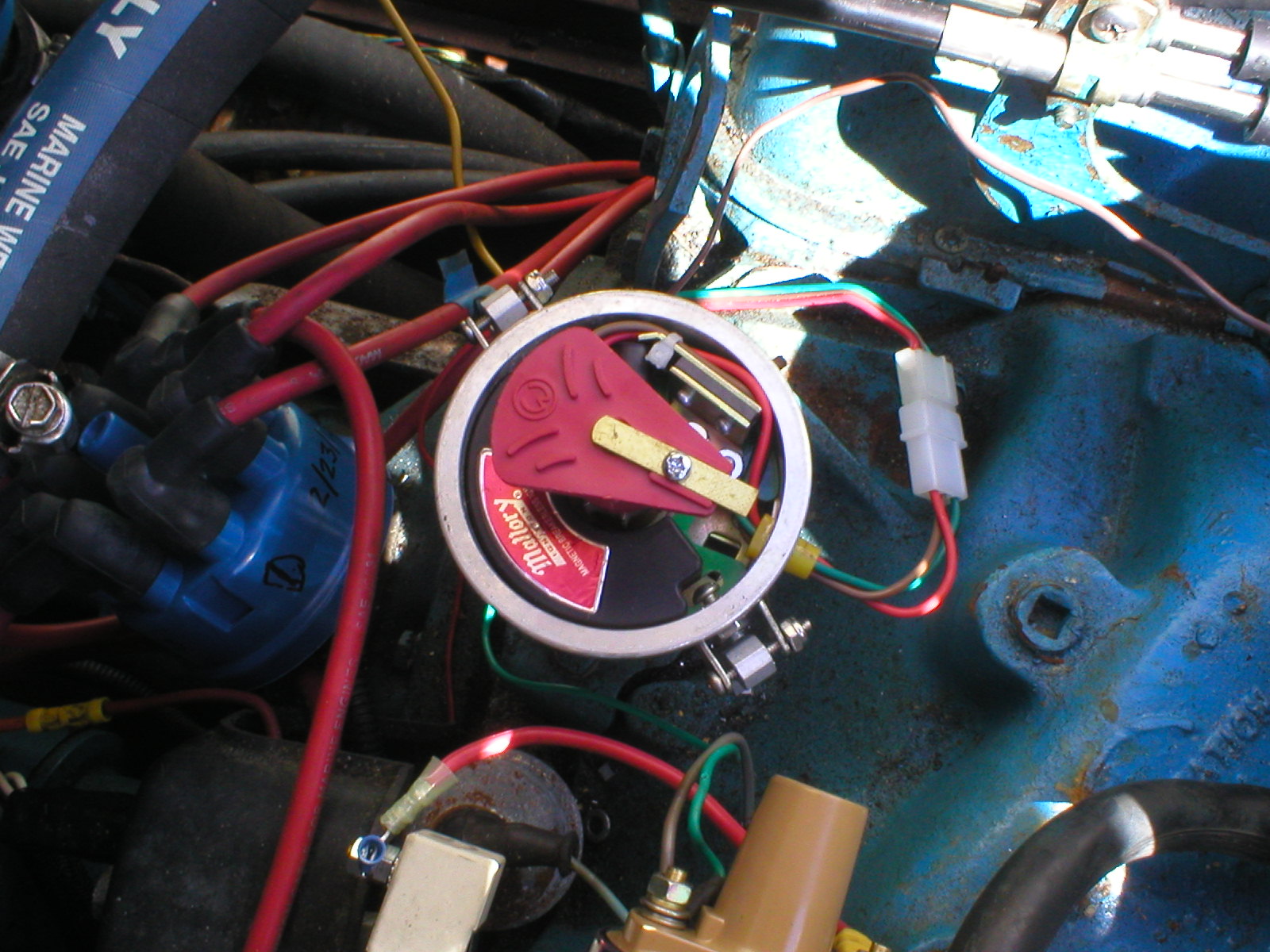
Here's the distributor with the new ignition module installed. We had to re-engineer the way the   distributor cap is held in place. There are now 6-32 machine screws with stop nuts rather than cheap-o pieces of aluminum rod holding the two distributor caps in place..


With all that done, we headed up to the cabin the start the starboard engine, which hadn't been run since last weekend.  We gave her one pump of the throttle to set the choke, turned the key and off she went and the settled into a nice 600 rpm idle. This was the engine that always needed to be cranked a few times to start.

Maybe we're on to something here. Sure hope to.

But did we really fix this problem?
Saturday evening, we kept turning this supposed repair over and over in our head. We don't really know if we have fixed whatever was killing the starboard ignition coils. Yes, we replaced everything in the starboard ignition system but without taking a 35 mile cruise, we really don't know.

We have an identical engine on the port side with exactly the same ignition parts that never, ever fails. We read back over the repair records, which could be titled, "So Many Coils and So Little Time." What is different about the starboard engine?

The obvious answer is that the starboard engine had an alternator regulator failure that damaged some electronic components and the port engine did not. That's the thinking that lead us to the replacement of the starboard ignition module in the first place.

On Sunday, after taking care of some business and then mowing the grass, we drove back down to the boat and puttered around, checking the fluid levels in the engines, transmissions and v-drives. Then, still thinking about the differences between the ignitions on the two engines, we took the distributor cap off the port (reliable) engine and used our piece of .047" Mylar to check the gap between what Mallory calls the reductor and the magnetic pickup. It was a very tight fit when we inserted our Mylar strip. 

We thought back to what that same measurement had been on the starboard distributor before we removed the old ignition module. It was much wider, perhaps 2-3  times wider than .047 and that was how it was when we originally took that new distributor out of the box two years ago. Thinking that was okay, we set the gap quite a lot wider than .047" when we installed the new ignition module. (Setting this gap isn't easy.) That was sloppy and we went back to the starboard distributor and after a number of attempts, set it at a very tight .047, just like the reliable old port engine.

With the new gap, the starboard engine started immediately and ran up through 3,000 rpm without an issue.

We know. Reading this post is like watching paint dry
We understand how boring all of this is, but the blog gives us a valuable history as to what we have done to fix this recurring problem. Soon, we'll cast off and head for Norwich for the summer. That cruise will tell the tale about whether or not we have found this elusive problem.

But just to make sure we get there, we'll have a couple of extra coils on board.

Saturday, April 27, 2013

Surprise! The boat is in the water

Getting the boat in the water on a particular date in the spring at Portland Riverside can be problematic. Months ago, we put Act Three on the list to be launched on April 23. Our friend Rob, who has a Luhrs 34 Express, put his boat on the list for the same date. We both expected our actual launch date to be at least two weeks later than that.

We were surprised on Tuesday afternoon when Karen from the boat yard called to say that our boat was in the water.  We drove down after work to check things out and there she was, in the well.


We climbed aboard and checked things out. No issues that we could see. No water streaming into the bilge. Just a lot of dirt from 5-plus months in winter storage.

Luckily, we had spent one late afternoon waterproofing the roof of the bridge enclosure.  We hung it off the deck in the back of our house and sprayed it with 303 Fabric Guard Water Repellent. (They don't pay us to mention the product name. It just seems to work.)

On Saturday, after tending to some important business stuff, we gathered up the sections of the bridge enclosure and headed back down to the boat.  By now, it had been towed into a slip.

Watching me (Bill) install the 12 sections of bridge enclosure is really good for a laugh.  The top is the most difficult and we noticed that it had shrunk ever so slightly, probably from the water repellent. The 11 side pieces, all of which zipper together, should be obvious, but somehow they never are. In a hour or so, we had them all installed. Looked pretty good to us.


We just had to sit down in the helm chair and look out the front. There's our Roadmaster up there waiting for us.

With the bridge enclosure up, we took a shot at starting the engines.  After all the re-wiring we did last winter, we wondered if everything was connected properly.

We primed the port engine with a teaspoon of gas, turned the key and after one preliminary fart, off she went.  Great water flow out the exhausts and the engine settled down to a nice 600 rpm idle without stalling.  Excellent oil pressure and charging voltage and as we watched, the electric choke opened and the engine temperature came up a little.

Then the same routine for the starboard engine. It farted twice before settling into a nice idle. No issues that we could see.

With all new transmission and throttle cables now installed, we checked the transmissions. Smooth, easy shifting forward and reverse.  All that work last winter has paid off.

The fly bridge looked like home. I wish we could have shoved off for a little cruise.


Even the gas gauge was good news, although we've learned not to reply on its accuracy.


We took one more picture as we left for the afternoon. She may be a little dirty but we think that even after 33 years, she looks okay.


That's our friend Rob's Luhrs next to us.  For you sharp-eyed readers, notice the similarity between the hulls?  Luhrs and Silverton were made by the same company and shared 34 ft. hulls. Actually, we like our boat better but Rob would probably say the same thing.

Saturday, April 20, 2013

Waxing a boat is not like waxing your car


This is what our shed looked like this weekend. We were alone here just two weeks ago but now that the weather is nice, everyone has arrived. Ahead is Tom's Egg Harbor. That's his wife and daughter painting the boot stripe. Next is a 28 ft. Luhrs that desperately needs a new deck. Don't know the owner but he his been here (and has needed a new deck) for years. Next on the left is a 1936 Wheeler, owned by Larry, a home improvement contractor. Larry's Wheeler is absolutely beautiful and when we first met him, his kids were little. Now, his teen age son works on the boat with his dad.


Next is a 31 ft. Silverton. Don't know who owns it. It stayed in the shed last summer. To the left is Mike's 1984 Silverton 34C. The picture doesn't do it justice. It is very well kept. Mike owns a machine shop of some kind and says that his wife loves to boat, as long it is tied to the dock. At far left is a Trogan 32 that appears to be a nice one.  This boat has been in the shed for several years so who knows what's going on there.

There was little left to do on Saturday except keep on waxing, so that's what we did.  We're compounding first and then waxing. It's amazing how much crap comes off the hull once you apply the compound. The cloths used to take the old compound off are clogged and dirty after just a few feet of the hull. Luckily, we hit the Dollar Store for a bunch of cheap towels and they work great. As soon as we get home, we throw them all in the washer and then hang them out to dry for the next day.

The Connecticut River is behaving nicely. The water is high but not flooding. Our in-water date is scheduled for April 23, but that's not going to happen. There are lots of big boats here and once spring arrives, some of the owners of these boats flip the crew $100 or so to get in the water ahead of those of us who have put our names on the schedule.  We're used to it. It's just the way things happen upriver.

There are two boats in the water. A good-sized motor sailor and a 32 ft. Nordic Tug.  As we took this picture, the owner of the tug came out and yelled, "Do you want to buy her?"  No likely.


No damage to the boat yard to speak of over the winter. Here are two spiles (pilings) that broke off at the "scum line," which is where the poles exit the mud of the river bottom. The little old guy who comes up the river every spring to replace broken spiles is now long gone.  Sorry we didn't get a picture of his barge, pile drive and mini-tug.


We did get the new water deck fill installed, finally. There were problems in locating the new fill in the old hole in the deck and we had to fabricate a new mount out of a piece of PCV. Looks okay and now it can be opened without a wrench.


Didn't take any pictures of us polishing. Too boring. We guess that all this compounding and polishing is good exercise. The results aren't all that great. The hull is now very smooth to the touch but the hull isn't glassy smooth. We may have to live with that.

As we left, we couldn't help but take one more picture of spring at Portland Riverside.


 Back again soon, hopefully in the water.

Saturday, April 13, 2013

We can't seem to wear out the ladder

But we certainly tried to wear out the ladder on Saturday.  We're trying to compound and wax the hull and at one point in the afternoon, we had mentally counted climbing up the ladder 40 times. We lost track after that and as you might imagine, as we write this, we are bone tired.

The Connecticut River is fairly high but nothing very alarming. If the spring melt and the resulting freshet continue as they are, we should be able to get in the water in three or four weeks.

Today we saw the first boat go downriver. It was a 34 ft. Silverton from Petzold's, which is just north of us in Portland. He was running with engines at an idle or just above and he was making at least 8 knots. Good luck to him, whoever he was.

We paid our $220 bill at the boat yard and immediately started a new tab with the purchase of new zincs. Has anyone noticed? These things have gotten increasingly expensive. We put two new zincs on each shaft and a new one on each rudder. The boat yard didn't have the little ones we need for the engine water intakes, so those were ordered.

You've probably seen zincs before but since we took pictures...


As you can see from the zinc shots, we're going to have to touch up the ablative bottom paint. Before we began that, we taped and repainted the starboard boot top stripe.  As you can see, it's fairly worn after two summers resting against the big fenders we use to keep ourselves off the dock finger in Norwich.


We didn't repaint the port side stripe because it has held up nicely. In our summer slip, that side has no finger and hence, nothing to rub against.

The starboard side stripe looked fine after painting. We used a 3-inch roller and tipped with a brush.


The photo makes the stripe look uneven but that's just the reflection. It looks fine.

As we compounded and waxed the starboard side of the hull (and the parts of the port side that we could get to) we noticed that at the bow, just under the anchor pulpit, there was lots of staining and discoloration. That's one spot we can't see or work on during the summer.  We rubbed out all the crap and black stains and waxed that area.


Let's write yet another check
On Sunday, we noted that it was April 14, the last date we could get a discount on our summer slip. We called the Marina at American Wharf in Norwich and luckily Ian, a nice young marina employee, was on duty to take our check. We gave Ian $2,711.92 ($75.00 per foot plus Connecticut sales tax) and had a chance to catch up on some marina gossip.

 Our dock box was still there and there was even a boat or two at A-dock. It's nice to walk the dock even though it's still a little early.


 Then it was off to Portland Riverside for an afternoon of fun.

As noted above, the "fun" consisted of applying ablative bottom paint to the spots where it had worn off the green barrier coat.  Using paint left over from last year (we waste nothing), we crawled under the boat and used a 3" roller and a small brush to cover the exposed spots. That actually only took an hour, a lot less time that we had predicted.

Then it was back to compounding and polishing the hull. This project isn't leaving the hull super glossy but it does make it very clean and smooth. We think we may have to live with the hull the way it is. After all, she's 33 years old.

The port side of the hull presents a problem when it comes to putting up our ladder to polish. There is a boat on a trailer quite close to us on that side. In fact, so close that we can't squeeze in between.


We may be able to find someone with a strong  back to help us push it out of the way a little.

Before we left, we checked on the condition of the Connecticut River. It's doing quite well, it turns out. The weather has been good for a slow snow melt in Vermont, so the river is high but doesn't look as though it will flood.

This ladder is usually at a very steep down angle. Today, it was horizontal.


Looking down river, the water is high but as almost always, beautiful.


Looked as though the electric had been hooked up. Or, maybe not.


See you next weekend.