Monday, October 17, 2016

Disabled boat sucessfully towed by three inflatables

NORWICH, CONN., October 15, 2016 - This morning, three A-dock captains joined forces to tow dockmate John's 27 ft. Bayliner Miss Nicky II to the Brown Park launching ramp where it was hauled onto a hydraulic trailer for the overland trip John's home in Massachusetts.

The Bayliner had suffered what marine experts call an "engine casualty" earlier in the summer that made the boat unable to operate under its own power. The owner will replace the engine over the winter.

Marina at American Wharf A-dock residents captains John H., Mike and Bob fired up their outboard engines early Saturday morning and by 9 a.m. had them ready, idling at the dock. 


The total horsepower of the towing group was estimated to be as high 20, but no one was exactly sure because of the various ages of the engines.  Given the cool weather, several of the inflatables had a noticeable sag but that sag certainly did not extend the enthusiasm of the captains.

At approximately 9:15 a.m., the Bayliner was pushed out of its slip by hand and the three towers took up their positions:


 Captain Bob towing from the bow, Captain John H. on the port stern and Captain Mike on the starboard stern. Captain John, owner of the Bayliner, stood at the helm to provide direction, encouragement and extra steering force.

We joined Pete and his assistant from Pete's Marine Services at the Brown Park launch ramp as the flotilla slowly made its way out of the marina. Pete positioned his hydraulic boat trailer down onto the ramp as the towing captains executed a perfect 90 degree turn to port and headed straight across the Norwich turning basin toward the ramp.

In what seemed like just a few minutes, the group had the Bayliner positioned close to the ramp.


 Captain Bob had a little difficulty passing the short bow line to Pete, who was standing on the trailer but, soon enough, the line was passed and Pete winched the Bayliner into perfect position. There were nods of approval as the hydraulic pads on the trailer lifted the Bayliner up out of the water.


Minutes later, Pete, now at the wheel of his truck, pulled the boat and trailer up onto the surface of the parking lot where the towing captains gathered to examine the slime on the Bayliner's outdrive.

For some reason, slime-covered outdrives are always interesting.

Captain John dismounted from the Bayliner via the swim platform as Pete and his assistant strapped the Bayliner down for its trip to Massachusetts.

All in all, it was a perfectly executed boat movement. In fact, it went exactly according to the plan, which had been developed in great detail days before over rations of Maker's Mark Bourbon.

This event was covered by A-dock's EyeWitness News Team.


Sunday, October 9, 2016

End of the season unloading


This weekend started with the first part of preparation for leaving Norwich for winter storage: checking the engines. We know we're old fashioned, but we always check the fluids in the engines, V-drives and transmissions as well as the condition of the belts and hoses before going anywhere. Once again, all looked well.

We also did some shopping for the supplies we'll need to winterize the engines and water systems. This year, Wal Mart came through with the best prices we could find for potable (pink) antifreeze and engine oil and filters.

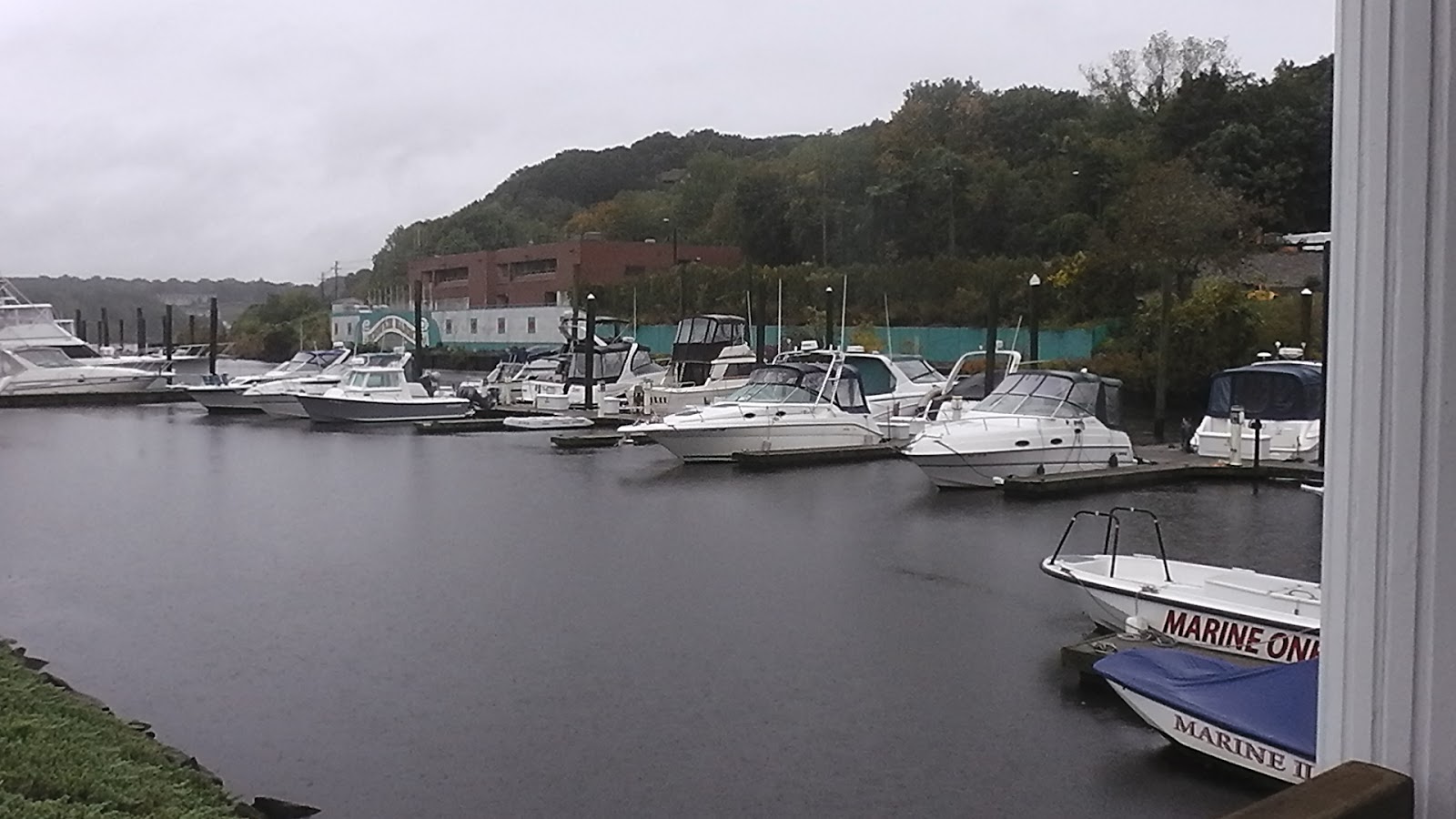
On Sunday, we had lots of rain, courtesy of hurricane Matthew, which headed offshore but left us with really lousy weather. But, as you can see from the photo above, there were quite a few boaters like us who were there to take stuff off of their boats.

A-dock, our summer home where we have had so much fun, looked pretty drab in the rain.


We also started taking any liquids off the boat that could freeze, excepting things that Frances and Pooka might need over the next week. We use those plastic crates that you can buy at discount stores and we filled a couple of them. We also off-loaded our pink anti freeze. Yes, there are 15 gallons of that stuff.


Here's why we do it this way. Our winter storage yard doesn't enable us to get very close to the boat with our car. Carrying a lot of antifreeze can be very difficult and energy consuming.

We think that it is always the safest way to run antifreeze through every plumbing element of the boat. Yes, we drain the water heater and then let it refill with antifreeze. That means we're protected from the on-board fresh water tank and then through every hot and cold water line on the boat, including the air conditioner. To winterize the engines, we connect them so that they suck up few gallons of pink antifreeze until it spills out the exhaust. Then we check the quality of the green antifreeze in the heat exchangers that actually cool the engines.

We hate to leave but we have to very soon.


Thursday, October 6, 2016

Getting gas - How boring is that?

Last weekend, we called for a pump-out. Our poop gauge was showing five red lights and that, my friends, is a true sanitary emergency.

We called for the pump-out boat but it wasn't working. Seems that the steering wasn't steering. Late Sunday, we found that a part had to be ordered and it wasn't going to become available until the next weekend.

By then it was too late on Sunday afternoon to take a cruise to the gas dock where the pump-out machine actually worked, so we planned to do it the next day, Monday.

Monday morning was beautiful.


We called on the radio for a dock attendant to give us gas and he was waiting. Feeling frisky, we decided to turn the boat around and dock port-side to the dock, because that's where both the gas filler and the pump out fittings are. Slid right up to the gas dock. Of course the fact that there was no wind and no current had little to do with it. Just pure, end-of-season skill.

Both the pump-out and the fueling were uneventful. We took just 66.7 gallons of gas, the least that we think we have ever needed. That gas will take up the Connecticut River to winter storage in Portland and bring us back to Norwich next spring for another fun summer.

We shot some video, this time with two cameras, one facing forward and one aft. It's probably a waste of seven minutes of time, but we like it. We should probably have a third camera dedicated to capturing Bill's confident hands on the controls or Frances heaving a docking line, which she does so well.

Maybe we'll do that next year.


Sunday, October 2, 2016

Spark plug wires - how boring is that?

Throughout this season, we noticed just a little miss in our starboard engine. Nothing major, but you could see it on the sync gauge. That engine would drop a few RPMs every once in a while. As the season went on, this became more frequent and by the time we took friends to Mystic a few weeks ago, it became a major problem that was resulting in increased fuel usage.

Time to fix it, and we focused on the plug wires because when the engine idled, we could hear a snapping sound and that sounded like spark.

The plug wires weren't that old. We installed them about six years ago and didn't replace them when we rebuilt the heads on that engine two winters ago. They looked good and aren't these things made out of long-lasting, space-age material?  Apparently not.

We had Packard Delecore II, 7-mm wires on that engine. On Chrysler marine 318 and 360 engines, they run from the distributor down between the heads and the exhaust manifold ports to the plugs. No matter how you try to secure them, that puts most of the wires in contact with the very hot manifolds and in our case, one or more of them failed.

We called http://www.marineengineparts.com/ our favorite supplier, and the guy who answered the phone confessed that 1980 Chrysler engines where "a little before his time." We coached him to sell us a plug wire set for big block GM engine, thinking that they would be longer, and they were. In fact, the new Magstar 801 8-mm wires were at least four inches longer than the old wires that were intended for our Chrysler engines.


On Saturday, we installed the new plug wires, running them outside of the exhaust manifolds so there is no contact between the plug wires and the manifolds. The engine started perfectly and ran without the old stumble. We'll put another set of these Magstar wires on the port engine this winter.


Pooka's health emergency
About two weeks ago, Pooka got sick. He was weak and obviously, something was very wrong. Frances rushed him to the animal hospital in nearby Marlborough where he was found to "shutting down" with a very low temperature. That's not good for cats and the Vet treated him, which included putting him in a incubator to bring his temperature back up. He was also tested for several important bodily functions and those tests came back as okay. In about five days and $800 in treatment costs, Pooka, the boat cat, came back to his summer home, apparently well again.

Pooka is an important member of our crew. It's great to see him back and home.


Just to show us that he was fully recovered, he climbed to the steps to the fly bridge and, for the first time, climbed back down without assistance. Go Pooka!

Frances cooked one of our favorite dinners while Pooka and I watched. It may be getting cold, but boating is still good.


Summer is definitely over
 We turned on the heat in the boat one night last weekend, just 12 hours or so after the temperature at the dock had been up to 80 degrees. A 40 degree change in temperature in one day really gets your attention, but that's New England weather. Unfortunately, that means that we have to begin planning to move the boat back to Portland, Connecticut for winter storage. That will probably take place in mid-October.

Even though the autumn weather can be beautiful, we really have to be careful. Several years ago, we went up at the end of October and when we went back to the boat the next day to winterize the engines, we had eight inches of wet snow on the boat. We learned the hard way that fly bridge enclosures aren't meant to support the weight of that much wet snow.


Monday, September 5, 2016

Labor Day Weekend: No boating around here


Not much boating this weekend at American Wharf (or anyplace else around here) as former hurricane/former tropical storm Hermine churns away off the coast. The sky was overcast for a lot of the time and we had to content ourselves with lots of socializing on the docks. That's something that A-Dock does very well.

A high spot for us was the fact that September 5 was Frances' birthday. Of course, she received a birthday crown and a bottle of wine from our dockmates.


And a shot of her sitting down, crown slightly askew... She'll wear that crown for the next week!


 One member of our crew couldn't care less about tropical storms or special birthdays. Pooka knows how to relax.


 The media loves to characterize Labor Day as the "end of summer" but for us it isn't. We have another 45 days or so of wonderful fall weather ahead of us. We're in a great "hurricane hole" so even if it blows, we're relatively safe. We have a few complaints about how the marina is run, but all in all, it's a nice place to be.


Wednesday, August 24, 2016

A Visit to Newport

We were invited to a very elegant wedding in Newport at the end of August. We're normally scruffy boaters, but for this occasion, we dragged out our best duds and headed out in the old station wagon.


Newport is a busy place in the summer but Frances was able to book us a room at the Pineapple Inn. It doesn't look like much but it turned out to be very nice, run by great people and only cost us a little more than $500 for the weekend. Oh, Frances made that reservation last winter so if you plan to visit and not spend the entire budget on a hotel, book early.

On Saturday, we (Frances' brother Fred and his wife, Kathy and Frances' sister Tina and her guy Dan) took a tour of the island, which was well worth doing. Our driver gave us a complete history of Newport that actually seemed pretty accurate and part of the tour included a stop at Fort Adams, where we got a good look at the harbor.


Our tour also included admission to two mansions and we selected The Breakers and Marble House on Bellevue Avenue. The Breakers (the most popular tourist destination in Rhode Island) is really overwhelming in size, especially considering that Cornelius Vanderbilt II, who built it, considered it a "summer cottage" and rarely spent much of his summers there.

One can only imagine sometime in the late 1800s when the butler called the staff together with the dreaded news that the boss was coming that weekend and will be giving a party for 200. Staff must have been busy especially considering that the vacuum cleaner wasn't invented until 30+ years later.


 As you'd expect, The Breakers "back yard" afforded a really great view.


 Next stop on our tour was Marble House, the summer "cottage" of William K. Vanderbilt. Built entirely of imported Italian marble (at a cost of $11 million in 1892), this place simply staggers the imagination. We guess it's worth noting that there was no income tax back in those days.


Needless to say, Marble House has a lot of stained glass windows and they are really breathtaking. These mansions aren't what we'd call exactly "homey" but they served their purpose, which was to impress a lot of other rich people, we'd guess.

Anyhow, seeing these two mansions was time well spent for us. It's always fun to see how these really wealthy people lived, even if they used these huge places for only a few days out of each summer.

On Sunday morning we took a hike along the Cliff Walk. We couldn't have asked for better weather but after a mile or so of the Cliff Walk, we certainly could have asked for better shoes. There were lots of rocky sections where we were only a few feet from the edge. Amazingly, there were no fences or the constant warning signs that we are used to here in Connecticut. It was nice to see people with their kids enjoying it all.

We shot just a small amount of video. Many of the people who follow this blog have been to Newport numerous times so the video is really just for us to look at next winter after clearing the snow from our driveway.

It was a fun weekend!


Sunday, August 7, 2016

Taylor Made


If you have more than a casual interest in boating, it's likely that you've heard of Taylor Made marine products. If you own anything but a high end yacht, it's likely that you own a Taylor Made product. We have several and that small hatch shown above is one of them.

We've gotten past the "fix that right now" stage of boat ownership to the "let's fix that before it breaks" mode and that's what we did this weekend. Case in point: one of the two small Taylor Made hatches, this one over our guest berths. It didn't leak and never has but it also didn't open. Time to get out the tools and take it apart.

But first, let's get this out of the way: No criticism of how the Taylor Made hatch was made. For its time, 36 years ago, it was probably a fine and inexpensive hatch and many thousands of Silverton boats came equipped with them, ours included.

To open the old hatch, we disconnected the two sliding struts from inside. The gasket around the hatch was in amazingly good condition but the struts were frozen. The two latches, one missing its knob, were also removed. Don't think these things were supposed to squeak when turned, but both of ours did.

With all the hardware removed and the hatch glass cleaned, we hit the local Ace Hardware for some new 8-32 stainless bolts and matching stop nuts and washers. We also bought some large neoprene washers, which we trimmed to fit.

The struts required a little more work. Penetrating oil eventually got them working and a lot of intense work with steel wool burnished off most of the corrosion. The missing knob was replaced with a wing nut that no one will ever notice. Better yet, it works, just like the missing knob did.

With all of the parts laid out on the deck and all of our tools in place for reassembly, a really spectacular thunderstorm blew in, forcing us back inside.

Once the weather cleared, we finished installing the parts and enjoyed being able to open and close that hatch easily.


But, at least for us, opening those hatches will be rare. In warm weather, our air conditioning makes the boat very comfortable. Underway, in most conditions, running with those hatches open invites hull spray or even water into the boat. Maybe the occasional guest in that berth may want to open that hatch and if so, they can.

At least now, the damn hatch opens and closes as it should.